How to Use a Lemon Vibrator When You Want Deeper Connection With a Long-Term Partner
Let's be real. After ten years, or twenty, or thirty together, sex often becomes functional. Not bad, not joyless, but predictable. You know each other's rhythms too well. The spontaneity has calcified into routine. And somewhere along the way, vulnerability got confused with weakness, so you stopped asking for what you actually wanted.
That's where a lot of couples get stuck. And that's also where a clitoral vibrator like a Lemon can become a real pivot point, not because it's a magic fix, but because it creates permission to renegotiate the entire conversation.
Why toys feel threatening (when they actually aren't)
Here's the thing nobody says out loud: introducing a toy into a long-term relationship triggers anxiety that has almost nothing to do with the toy itself. Partners worry they're being replaced. People with vulvas worry they're admitting something was wrong the whole time. Both feel like they're confessing a need they should have already had met.
None of that is true.
What's actually happening is that pleasure has become a fixed point in the relationship, and you're about to make it variable again. That feels risky because it is risky. But risk is also where deeper intimacy lives.
I worked with a couple last year, married eighteen years, who hadn't had sex in almost two years. Not because of anger or infidelity. Just slow distance, one decision after another to skip it, until it became too awkward to restart. When they introduced a lemon clitoral vibrator, the actual object mattered less than what it symbolized. It said: we're allowed to change the rules. We're allowed to admit this stopped working. We're allowed to try something new.
They had more connected sex in the month after introducing the toy than they'd had in the previous five years combined.
The conversation before the toy
Don't just leave one on the nightstand. That's not intimacy, that's a ambush.
Start with curiosity, not defense. "I've been thinking about trying something new together. Not because anything's wrong, but because I want to feel closer and more present with you." Notice that you're not saying "I need this to get off." You're saying "I want this for us."
If your partner pushes back, listen to the actual fear under the pushback. "Will you need this every time now?" means they're worried about being replaced. "Do you think I'm not enough?" means they're interpreting your need as a criticism. Neither of those worries goes away by ignoring them.
Address them directly. "This isn't about you not being enough. It's about both of us getting to explore something together that we haven't before. I want you there with me. That's actually why I'm asking."
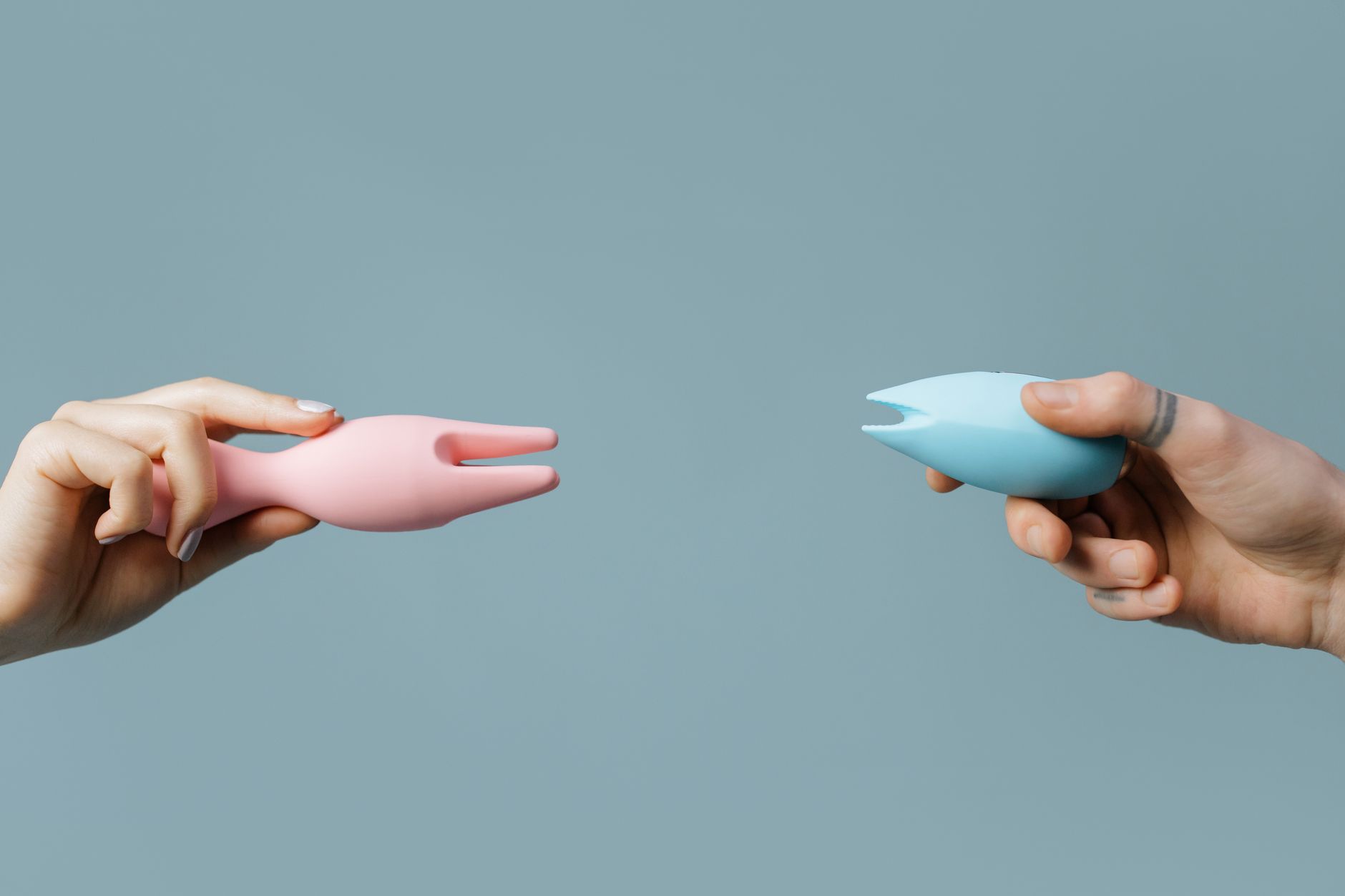
Photo by cottonbro studio on Pexels
The first time, together
Don't treat this like a performance. You're not trying to achieve the most intense orgasm of your life. You're trying to practice being vulnerable in front of someone you trust.
Start with clothes on, if that feels safer. Show your partner the lemon vibrator. Let them hold it. Let them ask questions. There's no version of this where you turn it on and dive in. That's how it becomes mechanical.
When you do use it together, the partner can hold it, or you can. What matters is that you're communicating the entire time. "That feels good." "A little slower." "I like when you watch me." These aren't sexy things you're supposed to say while maintaining an expression of effortless pleasure. They're real things, said at normal volume, in your actual voice.
This might be the least porn-like experience of your life, which is exactly why it works.
What changes in a long-term partnership
Three things, consistently:
First: You stop performing and start being present. When you're focused on what a toy feels like, you can't simultaneously perform enjoyment for your partner. That shift from performance to presence is where real intimacy begins.
Second: Your partner gets to see you as a person with wants, not just as someone who's supposed to always be ready. For decades, you've probably edited your needs. With a toy on the table, that edit becomes harder to maintain. And when you stop editing, your partner gets access to the real version of you.
Third: You rebuild permission. Permission to ask for what you want. Permission to say no. Permission to change your mind. Permission to be a person who wants things and is willing to say so.
That permission leaks out of the bedroom. Suddenly you're speaking up about other things too. Not because the toy is magic. Because you've practiced being honest in the most vulnerable space available to you.
Practical setup for sustained pleasure
If you're using a lemon clitoral vibrator for connection, a few things help:
Lubricant matters. Water-based, always. It's not about needing it, it's about comfort, and comfort is the foundation of vulnerability.
Start at a low intensity. This isn't a test of how much stimulation you can take. It's practice in being present with sensation. The Lemon has multiple intensity settings for exactly this reason. Start at one or two, and move up only if you want to.
Take your time. Twenty minutes is not too long. If your partner is involved, they can rest their hand when they need to. If you're using it alone while your partner watches or touches you elsewhere, same principle. Slow is better than fast. Sustainable is better than intense.
When it stalls or doesn't hit right
This is important: if you use a toy and nothing changes, that's usually not about the toy. It's about what you're still not saying.
Sometimes couples introduce a vibrator and it feels exactly the same as before, just with an object involved. That means the real conversation still hasn't happened. The one where you admit that sex stopped feeling connected. The one where you confess that you're scared. The one where you ask for something you've never asked for before.
The toy is a tool, not a conversation replacement. If you're using it to avoid the conversation, it won't work.
If you're using it to create space for the conversation, watch what happens.
The deeper shift
The couples I work with who experience the most change aren't the ones who use toys most frequently. They're the ones who used a toy as a way to restart a conversation about desire, about vulnerability, about what they want from each other.
Sometimes that conversation leads to regular toy use. Sometimes it doesn't. But the permission stays. The knowing that you can ask for what you need. That your partner is willing to listen. That desire can be renegotiated at any point, not just once at the beginning of the relationship.
That's what a lemon clitoral vibrator actually opens up. Not better orgasms, though that might happen. Deeper connection, and the willingness to be honest about what you want. After years together, that's the most intimate thing available.
People Also Ask
How do I bring up using a vibrator if my partner has never wanted toys before?
Start with your own experience, not the tool. "I've been reading about how many people use vibrators and it made me curious about exploring more sensation together." Frame it as curiosity, not critique. If your partner still says no, that's information too. It might mean they need time, or different messaging, or that this specific thing isn't going to happen. Respect that. Forced novelty isn't intimacy.
Will my partner feel like they're not enough if I use a toy?
Possibly, at first. That feeling usually means they need to hear explicitly: "This isn't about you. This is about me getting to experience my own body differently, and I want you there because being witnessed by you matters." The difference between a toy and betrayal is presence and inclusion. Make sure your partner knows they're included.
What if using a vibrator together makes things more awkward?
That awkwardness is usually data that the real conversation hasn't happened yet. The one about why sex stopped feeling good, or connected, or worth prioritizing. Awkwardness is often just vulnerability before it's been named. Sit with it. Ask your partner what they're feeling. The toy might need to go away for a while, and that's fine. The conversation is more important.
How often should we use a toy if we're trying to reconnect?
There's no right answer. Some couples use it every time. Some use it once a month. Some introduce it and then put it away for a year and come back to it. What matters is that it's a choice, not a requirement. The moment it becomes obligatory, it stops being intimate.
Can we use a vibrator if my partner is hesitant about their body?
Absolutely, and sometimes a toy actually helps with that. If your partner is uncomfortable being watched or touched, a vibrator shifts the focus to sensation rather than appearance. You can also use it alone first, letting your partner get comfortable with the idea before bodies are exposed. Vulnerability is a skill that gets stronger with practice.
What if we've tried toys before and it didn't help?
Most likely, the toy was attempting to solve a problem that the toy can't solve. If sex feels disconnected because you're not talking about what you want, a vibrator won't fix that. If sex feels obligatory, a vibrator makes it obligatory plus complicated. Tools work best when the foundation is already there. Sometimes you need to address the foundation first.